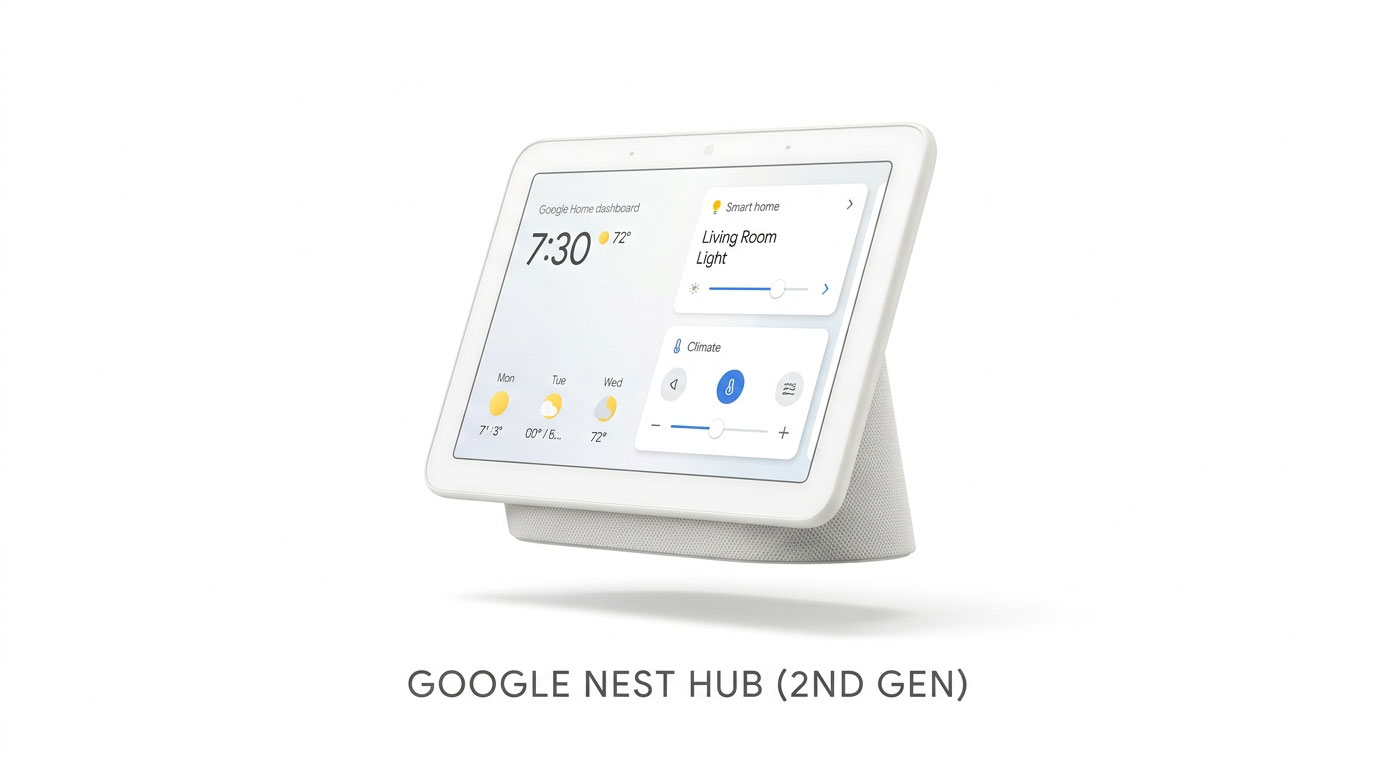
Smart displays have evolved into the indispensable command centers of modern connected living. Having a centralized, always-on screen lets you orchestrate household routines, stream live security camera feeds, and check morning weather forecasts without constantly reaching for your smartphone.
However, many popular smart displays bring an unwanted guest into your private sanctuary: a built-in camera lens. Positioning an active camera on your bedroom nightstand or bathroom vanity often feels like a glaring privacy intrusion.
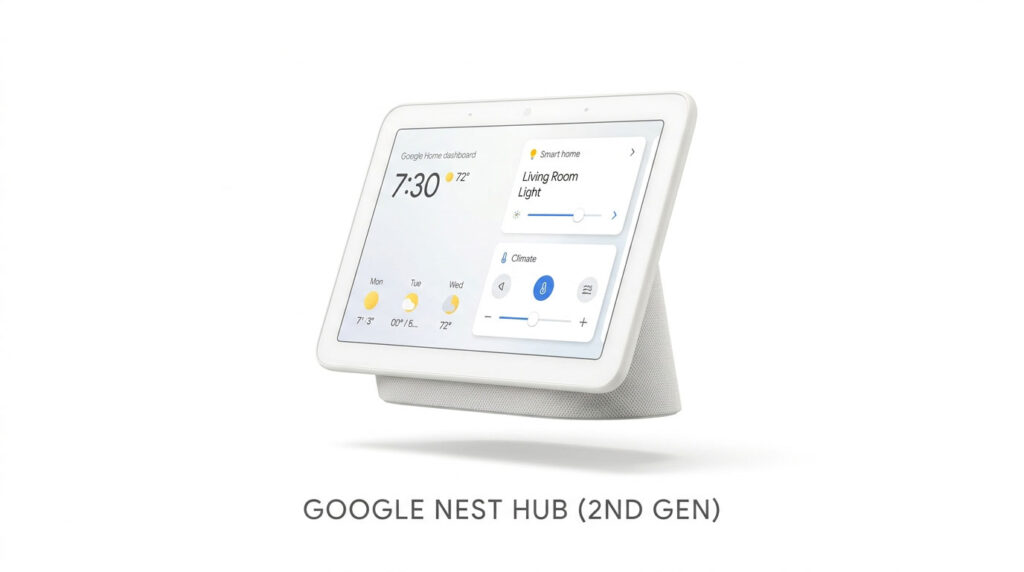
The Google Nest Hub (2nd Gen) solves that dilemma completely. By omitting a camera lens entirely, Google engineered a sleek, privacy-first smart display tailored specifically for nightstands, desks, and kitchen counters. Yet, it doesn’t skimp on innovation: equipped with miniature Soli radar technology, it introduces contact-free Sleep Sensing and intuitive air-gesture controls alongside 50% stronger bass.
In this comprehensive Google Nest Hub (2nd Gen) review, we evaluate its contact-free sleep tracking precision, audio performance, Google Assistant voice capabilities, smart home dashboard utility, and whether it remains the smartest centerpiece for your living space.
Quick Verdict & Review Scorecard
| Evaluation Metric | Score | Key Takeaway |
| Privacy & Form Factor | 10 / 10 | Completely camera-free design makes it 100% safe for bedrooms and private spaces |
| Smart Sleep Sensing | 9.5 / 10 | Soli radar accurately tracks sleep staging, coughing, and snoring without wearables |
| Smart Home Control | 9.6 / 10 | Intuitive pull-down dashboard for lights, thermostats, locks, and security cameras |
| Voice Recognition | 9.4 / 10 | Triple far-field microphones and onboard machine learning chip ensure rapid responses |
| Display & Ambient EQ | 9.2 / 10 | 7-inch panel adjusts color temperature seamlessly to blend like a physical picture frame |
| Audio Fidelity | 8.6 / 10 | 50% more bass than Gen 1; clear dialogue for podcasts, though modest for audiophiles |
| Overall Score | 9.4 / 10 | Editor’s Choice: The Best Privacy-Focused Smart Display for Android & Google Users |
Technical Specifications at a Glance
| Specification | Hardware Details |
| Retail Price | $99.99 (USD) |
| Display | 7-inch LCD Touchscreen (1024 x 600 resolution) with Ambient EQ light sensor |
| Camera | None (100% Camera-Free for absolute privacy) |
| Sensors | Soli radar sensor for Motion Sense, Ambient EQ light sensor, Temperature sensor |
| Audio Hardware | Full-range speaker with 1.7-inch (43.5 mm) driver (50% more bass than Gen 1) |
| Microphones | 3 far-field microphones with physical hardware mic-mute toggle switch |
| Processor | Quad-core 64-bit 1.9 GHz ARM CPU with high-performance ML hardware engine |
| Smart Ecosystem | Google Assistant, Google Home, Matter-ready, Thread border router support |
| Connectivity | Wi-Fi 802.11b/g/n/ac (2.4 GHz / 5 GHz), Bluetooth 5.0, Chromecast built-in |
| Dimensions & Weight | 120.4 mm (H) x 177.4 mm (W) x 69.5 mm (D); 558 grams (19.7 oz) |
| Colors Available | Chalk, Charcoal, Sand, Mist |
1. Design & Display: The Invisible Bedroom Companion
Unlike cold, industrial tech gadgets, the Google Nest Hub (2nd Gen) adopts a soft, warm aesthetic that integrates naturally into home decor.
Design & Hardware Highlights:
– Floating Display : 7-inch glass display rests gracefully atop an angled, fabric-covered speaker base
– Ambient EQ Sensor: Dynamically shifts screen brightness and color temperature to match ambient room light
– Edged Glass Face : Bezel-free glass panel wipes clean easily and avoids dust accumulation
– Eco-Conscious : The fabric enclosure is crafted from 54% post-consumer recycled plastic
The Magic of Ambient EQ
What makes the Nest Hub truly special on a nightstand is its Ambient EQ light sensor.
Instead of glowing like an intrusive, eye-straining phone screen in the dark, the display automatically dims to a faint, minimalist clock when you switch off the bedroom lights. In broad daylight, it adjusts its color warmth to look identical to a printed photograph, making it the most convincing digital photo frame on the market.
2. Soli Radar & Quick Gestures: Touchless Convenience
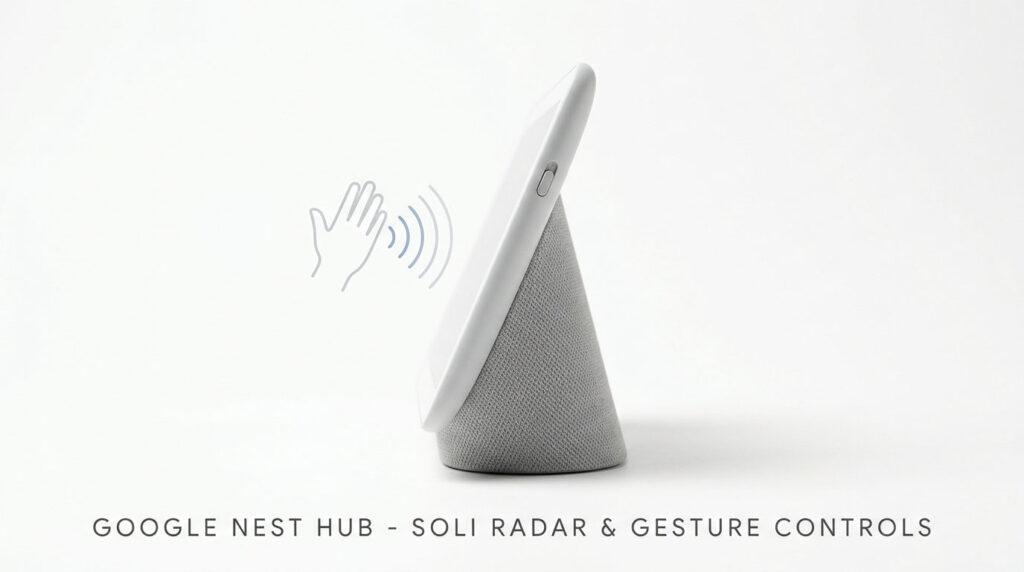
Embedded within the top bezel of the Nest Hub sits a miniature Soli radar sensor. Originally developed for advanced gesture detection, Soli emits safe, low-power sub-millimeter radio waves that detect motion without capturing optical images.
Touchless Radar Capabilities:
– Air Gestures : Tap the air in front of the screen with your palm to pause/resume music, timers, or YouTube
– Alarm Snooze : Wave your hand toward the display in the morning to snooze your wake-up alarm
– Proximity Sense: Wakes up the interface as you walk into the room, showing pending notifications
This hands-free functionality is a massive convenience in the kitchen when your hands are covered in flour or chicken marinade, or early in the morning when you want to silence a blaring alarm without fumbling for glasses.
3. Contact-Free Sleep Sensing: Wearable-Free Nightly Tracking
The most innovative breakthrough uncovered in our Google Nest Hub (2nd Gen) review is Sleep Sensing.
While devices like the Samsung Galaxy Ring or Oura Ring 4 require wearing hardware to bed, the Nest Hub tracks your sleep entirely through the air:
Sleep Sensing Metrics Tracked:
– Respiratory Rate : Soli radar monitors the microscopic rise and fall of your chest as you breathe
– Sleep Staging : Breaks down your sleep timeline into Restful, Light, and Disturbed periods
– Disturbance Audio: Ambient mics detect coughing, throat-clearing, and snoring frequency
– Room Climate : Correlates temperature and lighting changes to nighttime wakefulness
Every morning, the screen displays a detailed sleep report that seamlessly syncs with the Google Fit and Health Connect apps on your Android smartphone. If a dry bedroom causes nighttime coughing spells, the Nest Hub flags the trend so you can run a humidifier.
4. Smart Home Dashboard & Doorbell Integration
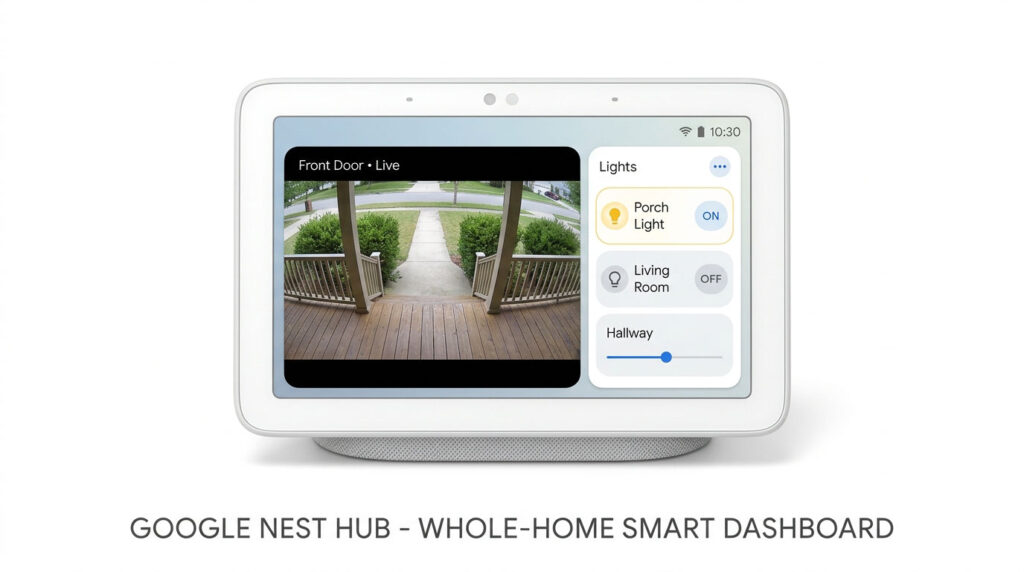
Swiping down from the top edge of the Nest Hub brings up the Home View dashboard, categorizing your connected devices into Rooms, Lights, Thermostats, Media, and Cameras.
- Doorbell Video Feeds: When paired with the Google Nest Doorbell (Battery), pressing the doorbell button instantly chimes the Nest Hub and automatically brings up a live, low-latency video feed. You can tap two-way quick responses right from the kitchen counter.
- Smart Lighting Automation: Touch-friendly sliders let you adjust the brightness or tweak color palettes across your Philips Hue or TP-Link Tapo smart bulbs without speaking out loud.
- Matter & Thread Border Router: The 2nd Gen Hub contains built-in Thread radio hardware, acting as a Thread Border Router to establish low-latency, self-healing mesh connections with modern Matter-certified smart home gear.
5. Audio Performance: Richer Acoustics and Deeper Bass
One major drawback of the original 1st-generation Google Home Hub was its thin, tinny speaker.
Google re-engineered the audio chamber on the 2nd Gen model:
- 50% Deeper Bass Response: Features a custom 1.7-inch full-range driver that outputs noticeably warmer low-end frequencies.
- Dialogue Clarity: Spoken vocals on podcasts, NPR news briefings, YouTube cooking tutorials, and audiobooks cut through background kitchen noise cleanly.
- Multi-Room Grouping: You can group the Nest Hub with other Google Cast speakers or soundbars throughout your home to fill every room with synchronized Spotify or YouTube Music streams.
(Audio Synergy: For focused private listening without waking sleeping household members, pair your setup with noise-cancelling earbuds like the Google Pixel Buds Pro 2 or Samsung Galaxy Buds3 Pro via Bluetooth.)
Google Nest Hub (2nd Gen) vs Amazon Echo Show 8
| Feature / Metric | Google Nest Hub (2nd Gen) | Amazon Echo Show 8 (3rd Gen) |
| Retail Price | $99.99 (Budget-Friendly) | $149.99 |
| Camera Lens | None (100% Bedroom Safe) | 13 MP Camera with physical shutter |
| Display Size | 7-inch LCD (1024 x 600) | 8-inch HD LCD (1280 x 800) |
| Contact-Free Sleep Tracking | Yes (Soli Radar Motion Sense) | No |
| Gesture Controls | Yes (Air Tap / Wave via Radar) | Yes (Via visual camera sensing) |
| Voice Assistant | Google Assistant | Amazon Alexa |
| Smart Protocols | Matter, Thread Border Router | Matter, Zigbee, Thread Border Router |
| Best Room Placement | Nightstand, Bedroom, Desk | Kitchen Counter, Living Room |
Pros and Cons
Pros
- Complete camera-free design offers absolute peace of mind on nightstands and in private bedrooms
- Soli radar enables contact-free sleep tracking, snore detection, and cough analysis without wearables
- Touchless quick gestures let you snooze alarms and pause audio with a simple wave of your hand
- Ambient EQ light sensor creates the most convincing, glare-free digital photo frame on the market
- Seamless video integration with the Google Nest Doorbell and smart security cameras
- 50% stronger bass output compared to the original generation
- Acts as a Thread Border Router and Matter controller for next-generation smart homes
- Highly competitive $99 price point
Cons
- No built-in camera means two-way video calling is unavailable (audio calls via Google Meet only)
- 1024 x 600 display resolution is modest compared to 1080p tablets
- Audio performance, while upgraded, is not tuned for audiophile-grade high-volume party music
- Sleep Sensing capabilities may transition into an optional premium service in the future
Frequently Asked Questions (FAQ)
Can I make video calls on the Google Nest Hub (2nd Gen)?
Because the device does not have a camera, you cannot transmit outgoing video of yourself. However, you can still participate in two-way audio calls through Google Meet, and you can receive one-way video feeds (e.g., viewing callers or looking through smart security cameras).
How does the Nest Hub track my sleep without a camera?
It utilizes miniature Soli radar technology located in the top bezel. The radar emits safe, low-energy radio waves that track movement, chest respiratory expansion, and restlessness. Cough and snore detections are analyzed locally using the far-field microphones, which can be physically disconnected via a mute toggle switch on the back.
Can I use the Nest Hub as a Bluetooth speaker?
Yes. In addition to casting audio directly from Spotify, YouTube Music, and Pandora over Wi-Fi, you can pair any Android or iOS smartphone to the Nest Hub via Bluetooth 5.0 to stream any media.
Final Verdict: Is the Google Nest Hub (2nd Gen) Worth Buying?
To wrap up our Google Nest Hub (2nd Gen) review, Google hit the sweet spot of functionality, design, and privacy. By deliberately excluding a camera lens, it eliminates the privacy dread common to smart devices while utilizing Soli radar to deliver touchless gestures and non-intrusive sleep monitoring.
If you are an Android user, smart home enthusiast, or someone searching for the ultimate digital alarm clock, photo frame, and home automation dashboard, the Google Nest Hub (2nd Gen) is the best privacy-friendly smart display you can buy today.
Explore our comprehensive buying guide to the Best Smart Home Devices to discover how the Nest Hub serves as the brain for the Google Nest Doorbell (Battery) Review. If you prefer wearable recovery tracking over radar, check out our reviews of the Samsung Galaxy Ring and the Best Smartwatches for Android.